Showing posts with label Keystone. Show all posts

Friday, May 31, 2013

State Department Inspector General Probing Keystone XL Contractor’s Conflicts of Interest

In yet another investigation into the Obama Administration’s activities, the State Department Inspector General is probing the conflicts of interest surrounding the contractor that performed the Keystone XL review,.
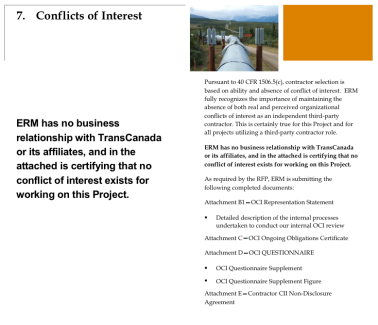
ERMProposalThe American public was supposed to get an honest look at the impacts of the Keystone XL pipeline. Instead, Environmental Resources Management (ERM), a fossil fuel contractor, hid its ties from the State Department so they could green light the project on behalf of its oil company clients.

Hiring an oil company contractor to review an oil pipeline that its clients have a financial interest in should be illegal – and it is. The Federal Government has strict laws to avoid conflicts of interest and prevent the hiring of contractors who cannot provide unbiased services.

Unredacted documents from the contractor’s proposal (revealed by Mother Jones) show that the company had worked for TransCanada, ExxonMobil and other fossil fuel companies that have a stake in the Canadian Tar Sands.

But, ERM misled the State Department at least twice in its proposal (see C&BP’s original post on ERM’s conflicts of interest)– which may have led to its selection by the State Department to review the Keystone XL pipeline.

OCI Question 6

First, ERM answered “No” to the question “Within the past three years, have you (or your organization) had a direct or indirect relationship (financial, organizational, contractual or otherwise) with any business entity that could be affected in any way by the proposed work?“ ERM appears to have added to the Yes/No questionnaire that, “ERM has no existing contract or working relationship with TransCanada.” Regardless of the addendum, the oil company contractor misled the State Department by checking “No” to the specific question above. Despite the fact that unredacted documents show that ERM worked for TransCanada and other fossil fuel companies with a stake in Keystone XL pipeline in the three years prior to its proposal.

Second, ERM claimed it was not an energy interest. The State Department question defines an energy interest in part as any company or person engaged in research related to energy development. Yet, ERM has worked for all of the top five oil companies and dozens of other fossil fuel companies. In other words, ERM is clearly an energy interest.

How can we trust ERM to perform an honest review of the Keystone XL pipeline, if it can’t answer a yes/no question honestly?

These misleading statements should have been flagged by the State Department and the contractor should not have been able to perform the review because of these seeming conflicts of interest.
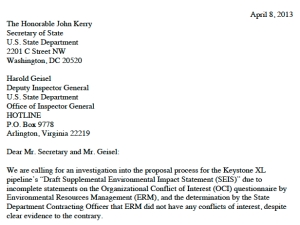
ERMLetterBecause of the issues above, Checks & Balances Project (C&BP) and 11 environmental, faith-based and public interest organizations sent a letter  [.PDF] on April 8, 2013, calling on Secretary of State John Kerry and the State Department Deputy Inspector General Harold Geisel to investigate two things: first, whether ERM hid conflicts of interest which might have excluded it from performing the Keystone XL environmental assessment and second, how State Department officials failed to flag inconsistencies in ERM’s proposal.

A few weeks later, C&BP received a voicemail from a Special Agent at the State Department’s Office of Inspector General (OIG):

Hello Mr. Elsner, my name is Special Agent Pedro Colon from the State Department’s Office of Inspector General.  I’m calling to inform you that we have received your request and are reviewing the matter.  If you have any questions please contact me at 703-284-2688.

On May 7, 2013, I called Special Agent Colon but he was unable to speak at the time. I followed up the next day and spoke with the Special Agent via phone regarding the request for an investigation. I asked a few basic questions about the status of the complaint and asked specifically if C&BP would be informed should the complaint be fully investigated by the Office of Inspector General (OIG). Special Agent Colon informed me that he could not speak to any of the questions and referred us to other staff in the OIG.

On May 9, 2013, I received an email from the OIG General Counsel saying, “that the complaint was being processed per the OIG hotline procedures and is under review.” (See the entire email correspondence here [.PDF])

I then asked the OIG General Counsel the same question he asked Mr. Colon:

If the hotline is moved out of the review process and onto the next step (an investigation?), will I be notified?

The OIG  replied via email saying that the OIG Office of Investigations will not comment if it is engaged in an investigation.

The correspondence between C&BP and the OIG indicates that there is a probe into the Keystone XL review conflicts of interest.

The public was supposed to get an honest look at the impacts of the Keystone XL pipeline. Instead, ERM, an oil company contractor, misled the State Department, in what appears to be an attempt to green light the project on behalf of oil industry clients.

The American Public needs a full investigation into the conflicts of interest and misleading statements of the Keystone XL review contractor, Environmental Resources Management.

Secretary Kerry needs to stop the Keystone XL process until the Inspector General completes a full investigation of these conflicts of interest and the State Department has an unbiased review of Keystone XL’s impact.

Filed under KeystoneXL Tagged with Big Oil, Checks and Balances Project, Energy, Energy Production, Environment, ExxonMobil, John Kerry, Keystone, Keystone XL, politics, Secretary Kerry, State Department, Tar Sands, TransCanada, US State Department


View the original article here

Wednesday, May 29, 2013

C&BP Calls for State Dept. Investigation into Keystone XL Consultant’s Conflicts of Interest

ERMLetterLetter to Secretary of State John Kerry and State Dept. Deputy Inspector General Harold Geisel

Originally posted on April 9, 2013. 

Yesterday, Checks & Balances Project and 11 environmental, faith-based and public interest organizations called on Secretary of State John Kerry and the State Department Deputy Inspector General Harold Geisel to investigate whether Environmental Resources Management (ERM) hid conflicts of interest which might have excluded it from performing the Keystone XL environmental assessment and how State Department officials failed to flag inconsistencies in ERM’s proposal. Tom Zeller, Senior Writer at The Huffington Post, wrote an article highlighting the letter callings for an investigation.

Early last month, the State Department released a 2,000 page environmental impact study for the Keystone XL pipeline claiming that the pipeline would not have major impact on the environment. But, Environmental Resources Management (ERM), the consulting firm hired to perform the “draft supplemental environmental impact statement (SEIS),” has ties to fossil fuel companies with major stakes in the Alberta Tar Sands. This conflict of interest was not accurately disclosed  in ERM’s answers on a State Department questionnaire. Checks & Balances Project considers ERM’s responses in its proposal to be intentionally misleading statements.

Unredacted Documents Uncover Conflicts of Interest
Last week, Mother Jones released unredacted versions of the ERM proposal, showing that three experts “had done consulting work for TransCanada and other oil companies with a stake in the Keystone’s approval.”

The unredacted biographies show that ERM’s employees have an existing relationship with ExxonMobil and worked for TransCanada within the last three years among other companies involved in the Canadian tar sands.

Here’s more from Mother Jones’ Andy Kroll:

“ERM’s second-in-command on the Keystone report, Andrew Bielakowski, had worked on three previous pipeline projects for TransCanada over seven years as an outside consultant. He also consulted on projects for ExxonMobil, BP, and ConocoPhillips, three of the Big Five oil companies that could benefit from the Keystone XL project and increased extraction of heavy crude oil taken from the Canadian tar sands.

Another ERM employee who contributed to State’s Keystone report — and whose prior work history was also redacted — previously worked for Shell Oil; a third worked as a consultant for Koch Gateway Pipeline Company, a subsidiary of Koch Industries. Shell and Koch have a significant financial interest in the construction of the Keystone XL pipeline. ERM itself has worked for Chevron, which has invested in Canadian tar-sands extraction, according to its website.”

When asked about who at the State Department decided to redact ERM’s biographies, a State Department spokesperson said “ERM proposed redactions of some information in the administrative documents that they considered business confidential.” Disclosing past clients may be business confidential information, but from what the biographies show, ERM may have recommended the redactions to hide conflicts of interest from public disclosure.

Problem with ERM Answers on Conflict of Interest Questionnaire 

ERMProposalERM’s Proposal to the State Department

The biographies on ERM’s proposal show that the company has had direct relationships with multiple business entities that could be affected by the proposed work in the past three years.

In the “Organizational Conflict of Interest Questionnaire,” the State Department asks (page 42), “Within the past three years, have you (or your organization) had a direct or indirect relationship (financial, organizational, contractual or otherwise) with any business entity that could be affected in any way by the proposed work?“ ERM’s Project Manager, Steve Koster, checked “No” but appears to have added to the Yes/No questionnaire that, “ERM has no existing contract or working relationship with TransCanada.”

Regardless of the addendum Koster added, he still submitted an incomplete statement when checking “No” to the specific question above. Simply put, the information provided by Mr. Koster was an incomplete statement if one simply reviews the biographies of ERM’s employees for the project.

The State Department Contracting Officer should have flagged this inconsistency when reviewing the staff biographies.  ERM’s answers did not properly reveal in the Yes/No questionnaire that ERM did have a current “direct relationship” with a business enetity that could be affected by the proposed work and a relationship in the past three years with TransCanada, the company building the pipeline.

Koster’s incomplete statement on direct business relationships is not the only odd statement in ERM’s proposal. ERM also answered “No” to the question, “Are you (or your organization) an ‘energy concern?’” which the State Department defines (in part) as: “Any person — (1) significantly engaged in the business of conducting research…related to an activity described in paragraphs (i) through (v).” Paragraph (i) states: “Any person significantly engaged in the business of developing, extracting, producing, refining, transporting by pipeline, converting into synthetic fuel, distributing, or selling minerals for use as an energy source…” ERM as a research firm working for fossil fuel companies is, unequivocally, an energy interest.

So the question must be asked: If ERM is unable to accurately fill out a simple questionnaire regarding conflicts of interest, how can we trust the company to perform an unbiased environmental assessment of a 1,179 mile-long pipeline cutting through the American heartland? And, why did the State Department’s Contracting Officer not flag the inconsistencies in ERM’s Conflict of Interest Questionnaire when reviewing the proposals?

Intentions of State Department and ERM in Question

The Federal Government has strict ethics rules to prevent Organizational Conflicts of Interest (OCIs) from impacting the impartiality of government contracts and to prevent hiring contractors who cannot provide independent and unbiased services to the government.

According to a white paper from the Congressional Research Service, before the State Department could choose ERM as the contractor, the “Contracting Officer” had to make an “affirmative determination of responsibility.” All government contractors (including ERM) must be deemed responsible, in part by meeting strict ethics guidelines, known as “collateral requirements.”

According to current collateral requirements, contractors must be found “nonresponsible” when there are unavoidable and unmitigated OCIs. Checks & Balances Project believes that the Contracting Officer should have deemed ERM “nonresponsible” because the company serves as a contractor for major fossil fuel companies that have a stake in the Keystone XL pipeline. If ERM were “nonresponsible”, the company would have been ineligible to perform the environmental impact review of the Keystone XL pipeline.

These potential material incomplete statements on a Federal Government proposal calls into question the integrity of ERM and threatens millions in government contracts.

If ERM were determined to be “nonresponsible” or “excluded” because of these incomplete statements, it could jeopardize ERM’s ability to perform any work for the Federal Government. Again, according to the Congressional Research Service:

“Decisions to exclude are made by agency heads or their designees (above the contracting officer’s level) based upon evidence that contractors have committed certain integrity offenses, including any “offenses indicating a lack of business integrity or honesty that seriously affect the present responsibility of a contractor.””

Certainly these incomplete statements call into question both the independence of ERM and the judgement of the Contracting Officer in making the “affirmative determination of responsibility.” This proposal process should be investigated by the State Department Inspector General to determine if ERM’s statements are cause for exclusion.

Groups Calling for Inspector General Investigation

We believe ERM used multiple material incomplete statements and had clear conflicts of interest as shown in the unredacted documents. So, why was ERM hired by the State Department?

Checks & Balances Project asked a State Department spokesperson about the conflicts of interest and the spokesperson said: “Based on a thorough consideration of all of the information presented, including the work histories of team members, the Department concluded that ERM has no financial or other interest in the outcome of the project that would constitute a conflict of interest.” Perhaps the State Department’s Contracting Offier made the decision to hire ERM because of the company’s incomplete statements on the conflict of interest questionnaire.

Harold Geisel, Deputy Inspector General, U.S. State Department

Checks & Balances Project along with 11 other groups (Better Future Project, Center for Biological Diversity, Chesapeake Climate Action Network, DeSmogBlog, Forecast the Facts, Friends of the Earth, Greenpeace, NC WARN, Oil Change International, Public Citizen’s Energy Program and Unitarian Universalist Ministry for Earth) sent a letter to Secretary of State John Kerry and the State Department Deputy Inspector General Harold Geisel calling for an investigation into the matter. These incomplete statements and the determination by the Contracting Officer that ERM did not have any conflicts of interest, despite clear evidence to the contrary, are grounds for further investigation.


View the original article here

Tuesday, May 28, 2013

C&BP Calls for State Dept. Investigation into Keystone XL Consultant’s Conflicts of Interest

ERMLetter Letter to Secretary of State John Kerry and State Dept. Deputy Inspector General Harold Geisel

Originally posted on April 9, 2013. 

Yesterday, Checks & Balances Project and 11 environmental, faith-based and public interest organizations called on Secretary of State John Kerry and the State Department Deputy Inspector General Harold Geisel to investigate whether Environmental Resources Management (ERM) hid conflicts of interest which might have excluded it from performing the Keystone XL environmental assessment and how State Department officials failed to flag inconsistencies in ERM’s proposal. Tom Zeller, Senior Writer at The Huffington Post, wrote an article highlighting the letter callings for an investigation.

Early last month, the State Department released a 2,000 page environmental impact study for the Keystone XL pipeline claiming that the pipeline would not have major impact on the environment. But, Environmental Resources Management (ERM), the consulting firm hired to perform the “draft supplemental environmental impact statement (SEIS),” has ties to fossil fuel companies with major stakes in the Alberta Tar Sands. This conflict of interest was not accurately disclosed  in ERM’s answers on a State Department questionnaire. Checks & Balances Project considers ERM’s responses in its proposal to be intentionally misleading statements.

Unredacted Documents Uncover Conflicts of Interest
Last week, Mother Jones released unredacted versions of the ERM proposal, showing that three experts “had done consulting work for TransCanada and other oil companies with a stake in the Keystone’s approval.”

The unredacted biographies show that ERM’s employees have an existing relationship with ExxonMobil and worked for TransCanada within the last three years among other companies involved in the Canadian tar sands.

Here’s more from Mother Jones’ Andy Kroll:

“ERM’s second-in-command on the Keystone report, Andrew Bielakowski, had worked on three previous pipeline projects for TransCanada over seven years as an outside consultant. He also consulted on projects for ExxonMobil, BP, and ConocoPhillips, three of the Big Five oil companies that could benefit from the Keystone XL project and increased extraction of heavy crude oil taken from the Canadian tar sands.

Another ERM employee who contributed to State’s Keystone report — and whose prior work history was also redacted — previously worked for Shell Oil; a third worked as a consultant for Koch Gateway Pipeline Company, a subsidiary of Koch Industries. Shell and Koch have a significant financial interest in the construction of the Keystone XL pipeline. ERM itself has worked for Chevron, which has invested in Canadian tar-sands extraction, according to its website.”

When asked about who at the State Department decided to redact ERM’s biographies, a State Department spokesperson said “ERM proposed redactions of some information in the administrative documents that they considered business confidential.” Disclosing past clients may be business confidential information, but from what the biographies show, ERM may have recommended the redactions to hide conflicts of interest from public disclosure.

Problem with ERM Answers on Conflict of Interest Questionnaire 

ERMProposal ERM’s Proposal to the State Department

The biographies on ERM’s proposal show that the company has had direct relationships with multiple business entities that could be affected by the proposed work in the past three years.

In the “Organizational Conflict of Interest Questionnaire,” the State Department asks (page 42), “Within the past three years, have you (or your organization) had a direct or indirect relationship (financial, organizational, contractual or otherwise) with any business entity that could be affected in any way by the proposed work?“ ERM’s Project Manager, Steve Koster, checked “No” but appears to have added to the Yes/No questionnaire that, “ERM has no existing contract or working relationship with TransCanada.”

Regardless of the addendum Koster added, he still submitted an incomplete statement when checking “No” to the specific question above. Simply put, the information provided by Mr. Koster was an incomplete statement if one simply reviews the biographies of ERM’s employees for the project.

The State Department Contracting Officer should have flagged this inconsistency when reviewing the staff biographies.  ERM’s answers did not properly reveal in the Yes/No questionnaire that ERM did have a current “direct relationship” with a business enetity that could be affected by the proposed work and a relationship in the past three years with TransCanada, the company building the pipeline.

Koster’s incomplete statement on direct business relationships is not the only odd statement in ERM’s proposal. ERM also answered “No” to the question, “Are you (or your organization) an ‘energy concern?’” which the State Department defines (in part) as: “Any person — (1) significantly engaged in the business of conducting research…related to an activity described in paragraphs (i) through (v).” Paragraph (i) states: “Any person significantly engaged in the business of developing, extracting, producing, refining, transporting by pipeline, converting into synthetic fuel, distributing, or selling minerals for use as an energy source…” ERM as a research firm working for fossil fuel companies is, unequivocally, an energy interest.

So the question must be asked: If ERM is unable to accurately fill out a simple questionnaire regarding conflicts of interest, how can we trust the company to perform an unbiased environmental assessment of a 1,179 mile-long pipeline cutting through the American heartland? And, why did the State Department’s Contracting Officer not flag the inconsistencies in ERM’s Conflict of Interest Questionnaire when reviewing the proposals?

Intentions of State Department and ERM in Question

The Federal Government has strict ethics rules to prevent Organizational Conflicts of Interest (OCIs) from impacting the impartiality of government contracts and to prevent hiring contractors who cannot provide independent and unbiased services to the government.

According to a white paper from the Congressional Research Service, before the State Department could choose ERM as the contractor, the “Contracting Officer” had to make an “affirmative determination of responsibility.” All government contractors (including ERM) must be deemed responsible, in part by meeting strict ethics guidelines, known as “collateral requirements.”

According to current collateral requirements, contractors must be found “nonresponsible” when there are unavoidable and unmitigated OCIs. Checks & Balances Project believes that the Contracting Officer should have deemed ERM “nonresponsible” because the company serves as a contractor for major fossil fuel companies that have a stake in the Keystone XL pipeline. If ERM were “nonresponsible”, the company would have been ineligible to perform the environmental impact review of the Keystone XL pipeline.

These potential material incomplete statements on a Federal Government proposal calls into question the integrity of ERM and threatens millions in government contracts.

If ERM were determined to be “nonresponsible” or “excluded” because of these incomplete statements, it could jeopardize ERM’s ability to perform any work for the Federal Government. Again, according to the Congressional Research Service:

“Decisions to exclude are made by agency heads or their designees (above the contracting officer’s level) based upon evidence that contractors have committed certain integrity offenses, including any “offenses indicating a lack of business integrity or honesty that seriously affect the present responsibility of a contractor.””

Certainly these incomplete statements call into question both the independence of ERM and the judgement of the Contracting Officer in making the “affirmative determination of responsibility.” This proposal process should be investigated by the State Department Inspector General to determine if ERM’s statements are cause for exclusion.

Groups Calling for Inspector General Investigation

We believe ERM used multiple material incomplete statements and had clear conflicts of interest as shown in the unredacted documents. So, why was ERM hired by the State Department?

Checks & Balances Project asked a State Department spokesperson about the conflicts of interest and the spokesperson said: “Based on a thorough consideration of all of the information presented, including the work histories of team members, the Department concluded that ERM has no financial or other interest in the outcome of the project that would constitute a conflict of interest.” Perhaps the State Department’s Contracting Offier made the decision to hire ERM because of the company’s incomplete statements on the conflict of interest questionnaire.

Harold Geisel, Deputy Inspector General, U.S. State Department

Checks & Balances Project along with 11 other groups (Better Future Project, Center for Biological Diversity, Chesapeake Climate Action Network, DeSmogBlog, Forecast the Facts, Friends of the Earth, Greenpeace, NC WARN, Oil Change International, Public Citizen’s Energy Program and Unitarian Universalist Ministry for Earth) sent a letter to Secretary of State John Kerry and the State Department Deputy Inspector General Harold Geisel calling for an investigation into the matter. These incomplete statements and the determination by the Contracting Officer that ERM did not have any conflicts of interest, despite clear evidence to the contrary, are grounds for further investigation.

Filed under KeystoneXL Tagged with Andrew Bielakowski, Andy Kroll, Better Future Project, Big Oil, BP, Center for Biological Diversity, Checks and Balances Project, Chesapeake Climate Action Network, Chevron, Conflict of Interest, Conflicts of Interest, Congressional Research Service, ConocoPhillips, DeSmogBlog, Disclosure, Energy, Environment, Environmental Resources Management, ERM, ExxonMobil, Federal Acquisition Regulation, Federal Government, Forecast the Facts, Friends of the Earth, Greenpeace, Harold Geisel, Huffington Post, Industry, John Kerry, Keystone XL, Koch Gateway Pipeline Company, Koch Industries, KXL, lobbying, Mother Jones, NC WARN, Oil Change International, politics, Public Citizen's Energy Program, Shell, State Department, Steve Koster, Tar Sands, Tom Zeller, TransCanada, Unitarian Universalist Ministry for Earth


View the original article here

Thursday, April 25, 2013

House Members Outline New Keystone XL Path

House Energy and Commerce Committee leaders on March 4 outlined a new path forward on the Keystone XL pipeline, releasing a discussion draft of legislation that will remove the project’s fate from the president’s hands and clear away the roadblocks preventing construction of the pipeline. The draft legislation, authored by Rep. Lee Terry (R-NE), will eliminate the need for a Presidential Permit and find that the Final Environmental Impact Statement (FEIS) issued by the Secretary of State on Aug. 26, 2011, shall satisfy all NEPA requirements. The legislation also limits the legal challenges that can be brought against the project to prevent further unnecessary delays.

The Keystone XL pipeline is a $7 billion jobs and energy infrastructure project that has been tied up in regulatory review for over four years. Last week, the State Department released its draft Supplemental Environmental Impact Statement (SEIS), which found that the pipeline, including the revised Nebraska route, would have limited adverse environmental impacts. This review follows the State Department’s initial analysis that lasted for more than three years and found the pipeline to be environmentally sound.

"It's been over four years and thousands of pages of environmental reviews. The experts have weighed in. Now is the time to build the Keystone Pipeline," said Terry. "If we see further delays as we have in the past; Congress is ready to act. This discussion draft is part of that process."

Energy and Commerce Democrats Jim Matheson (D-UT) and John Barrow (D-GA) partnered with Rep. Terry to co-author the legislation that would allow construction of the pipeline to move forward.

"Construction of the Keystone XL pipeline is long overdue. This project creates thousands of high-paying, high-skilled jobs, and puts America on a long-term path to energy independence," said Matheson and Barrow. "Multiple reviews by the Obama Administration indicate that this pipeline will have no significant environmental impacts. This delay is just playing politics with American jobs and American energy security, and it’s time to move forward with construction of the pipeline."

House Energy and Commerce Committee Chairman Fred Upton (R-MI) and Energy and Power Subcommittee Chairman Ed Whitfield (R-KY) were also co-authors of the bill and committed to moving the bipartisan solution through the committee.

"Rep. Terry has been a leading champion for Keystone in the House and he will continue to carry the torch as we work to stop the administration’s delays and get this pipeline built. We have already waited four years for this pipeline, and without congressional action, we can expect the waiting to continue," said Upton and Whitfield. "We should learn from our experience with the Trans-Alaska Pipeline and act swiftly to move this legislation through the committee and through the House so we can stop waiting and start building and get folks back to work."

This is the fourth piece of legislation authored by Rep. Terry to advance construction of the job-creating Keystone XL pipeline. Last Congress, the House voted a total of six times to allow for construction of the Keystone XL pipeline, which is estimated to create thousands of direct and indirect jobs and carry nearly a million additional barrels per day of secure Canadian oil supplies to U.S. refineries.

Generated by readers, the comments included herein do not reflect the views and opinions of Rigzone. All comments are subject to editorial review. Off-topic, inappropriate or insulting comments will be removed.

View the original article here

Wednesday, May 9, 2012

Washington Post: Keystone XL Rejection Has ‘Little Rational Basis’

More on the Keystone XL pipeline. The Washington Post editorializes:

“President Obama’s refusal so far to authorize Keystone XL has little rational basis. … Attracting foreign investment in projects that will create U.S. jobs requires predictable regulatory procedures. The way to encourage the efficient extraction and delivery of the oil that the United States will require for decades is to make clear that government won’t use the issue as a political football.”

The editorial makes a couple of other points:

Opponents of Canadian oil sands (and the Keystone XL) are mistaken to believe that stopping the pipeline will keep 170 billion barrels of oil in the ground – because Canada has other means to get the oil to market, as well as other markets willing to buy it.Political skirmishing in Washington has been detrimental to overall progress on the project.

Meanwhile, POLITICO has this guest opinion piece by Karl Rove, pointing to the administration’s Keystone XL rejection as a prime example of a self-inflicted inability to create jobs:

“Exhibit A is the Keystone XL pipeline. It would have brought oil from Canada’s tar sands and North Dakota’s prolific Bakken field to Gulf Coast refineries, factories and chemical plants. This would have created tens of thousands of private-sector jobs and reduced U.S. dependence on [imports]. … No matter. Extreme environmentalists opposed this vital infrastructure project. Rather than offend them, President Barack Obama blocked the pipeline’s construction.”

The two pieces help underscore the point that there are no good reasons to hold up the Keystone XL project, and that the administration is squandering a great opportunity to create jobs and help strengthen U.S. energy security. As the Post says, the president’s refusal to approve this shovel-ready project makes little rational sense.

An all-of-the-above energy approach must include oil and natural gas because it is our primary energy source now and into the future. The Keystone XL pipeline would be an integral part of such a strategy, which could see all of our liquid fuel needs met domestically and from Canada by 2024.


View the original article here

To the President’s Ear: Build the Keystone XL

In an interview with Fox Business Channel this week, billionaire Warren Buffett voiced support for construction of the Keystone XL pipeline:

"I’m not an expert, but it certainly seems like it makes sense to me. There are an awful lot of pipelines running in the United States and net, they've certainly been a huge plus for the country. … Based on what I know, I would say it makes sense.”

That the “Oracle of Omaha” supports the Keystone XL is significant. That Buffett’s support for the project follows similar opinions by others known to have the president’s ear is important as well. These include:

Former President Bill Clinton (Feb. 29, 2012):

“I think we should embrace [the Keystone XL pipeline] and develop a stakeholder-driven system of high standards for doing the work." 

AFL-CIO President Richard Trumka (May 6, 2012):

“[America’s unions] are not divided on the pipeline itself. They are divided on how the pipeline is done. … I think we are all unanimous by saying we should build the pipeline, but we have to do it consistent with all environmental standards, and I think we can work that out, I really do, and we are for that happening.”

Former Obama ‘car czar” Steve Rattner (Jan. 5, 2012):

“My instinct is [the president] should approve it. My instinct is we need the energy, we need the jobs and it can be done in a safe way.”

Let’s see. That’s one of the most successful businessmen in the history of the planet, a former president, one of organized labor’s top leaders and one of the administration’s former leading economic policy advisors – all in favor of the Keystone XL, a project that would create jobs, deliver energy and help boost our country’s future energy security.

The president is the reason the Keystone XL remains on the drawing board. He has the authority to end more than three years of reviewing and delaying. API Executive Vice President Marty Durbin, in a conference call with reporters:

“We’d like to remind the president and the Congress that bipartisan majorities in both the House and Senate have voted in favor of the Keystone XL project, and a recent Gallop poll shows strong public support for project by a 2-1 margin.  In addition, the state of Nebraska is fully engaged in a process to quickly choose a new route that avoids sensitive areas. To borrow from the president’s campaign, it’s time to move forward on this critical project.  Keystone XL is as ‘good-to-go’ as it gets.”

To recap: Buffett, Clinton, Trumka, Rattner. The president has listened to them before. Is he listening now, on the Keystone XL?


View the original article here

Facts, Not Excuses, Should Guide Decision on Re-Routed Keystone XL

It’s good to hear that TransCanada has submitted its new application for a presidential permit to build the Keystone XL pipeline. The application comes just weeks after the Nebraska legislature approved a bill to move forward with a new route in that state that avoids the sensitive Sand Hills region.

Even better news would be that the White House, after a long list of excuses that prevented timely approval of the project, is now ready to give the go-ahead – dropping a position that a Washington Post editorial said has “little rational basis.” That analysis is reinforced not only by public opinion, but also by economic and environmental data. For example:

Americans support construction of the Keystone XL by nearly a 2-1 margin, according to a recent Gallup poll.A bipartisan, veto-proof majority in the U.S. House of Representatives recently voted to support construction of Keystone XL, the fifth time the House has backed the project. In March, 56 U.S. senators voted in favor of building the Keystone XL.More than 80 percent of Americans believe U.S. policies should support the use of oil from Canada’s oil sands.According to the U.S. Pipeline and Hazardous Materials Safety Administration, pipelines are the “safest and most-effective” way of transporting oil and natural gas. In addition, a comprehensive environmental assessment from the federal government concluded that the Keystone XL would have only “limited” impacts and be the safest pipeline ever constructed under current regulations.With unemployment still above 8 percent nationwide, the Keystone XL not only would create thousands of new jobs but also would help preserve jobs at U.S. refineries and production sites.While there are many factors that affect the price of gasoline families use to fill up their tanks, approving the Keystone XL would send a strong market signal that more supply is on the way, helping put downward pressure on the global price of crude oil, which accounts for 76 percent of the price paid at the pump. The pipeline could bring upwards of 830,000 barrels per day of Canadian oil from Alberta to U.S. refineries, with approximately 25 percent of the pipeline’s capacity used to deliver oil from North Dakota and Montana.

The application also comes as a new poll finds that Canadians support increased oil sands development by about a 2-1 margin. Among all provinces, the lowest level of support was in Quebec, where a clear majority – 55 percent – still supports development.

API Executive Vice President Marty Durbin said it’s time to approve the Keystone XL:

“The earth hasn’t moved, the geology hasn’t changed, the information remains the same, so there should be no reason for a re-review of KXL. The pipeline will be state of the art and has already been thoroughly examined for more than three years, including three environmental assessments. … The president should take this opportunity to approve the entire pipeline to demonstrate he is serious about an ‘all the above’ energy strategy. There is no legitimate reason for delaying this project any further. … We urge President Obama to support this project that will make us more energy secure.”


View the original article here

Friday, April 27, 2012

Rhetorical Engagement on the Keystone XL Pipeline

Rounding up some of the latest rhetoric by Keystone XL pipeline opponents – separating fact from fiction (and utter fantasy) – while striving for an informed energy discussion. It’s not easy.

Let’s start with a great big fact:

The U.S. Energy Information Agency (EIA) reports that oil and natural gas supply 62 percent of the energy we currently use. In 2035, EIA says oil and gas still will supply about 60 percent of the energy we use.

That’s the energy reality, according to the government. We run our economy and our lives on oil and natural gas. It’s the energy of today and tomorrow. Yes, America will need all energy sources in the years to come, but any notion that we can embark on an “off-oil” strategy without severe economic and social repercussions is uninformed, disingenuous or, as suggested above, fantasy.

Against that backdrop let’s review a couple of recent energy-related offerings – one that links the Keystone XL’s construction and Canadian oil sands production to the possible destruction of other cultures and the environment. Another serves up some warmed-over gasoline exports myths.

Post #1:

“It is undeniable that Keystone XL would bring about immense devastation to other cultures. Consider the members of Canada's First Nations groups, who have been more vocal about the need to stop the pipeline than almost anyone else. If Keystone XL were approved, their way of life would enter a rapid downward spiral and ultimately collapse.”  

Actually, this is deniable. First, a number of pipelines already crisscross energy-rich Alberta:

Click on the map for a larger view, and you’ll see the red dotted line representing the Keystone XL follows a path already taken by other pipelines in Canada. The idea that the Keystone XL would threaten anyone as described in the post is ridiculous.

Second, click on the link in the post and you’ll see that opposition from the First Nations groups is mostly directed toward a pipeline that would go west from Alberta to the coast, a proposal that has gained traction as Canada started thinking about other customers for its oil – following the Obama administration’s Keystone XL rejection.

Let’s go on. The post makes claims about environmental devastation from the proposed pipeline: 

“In order to exploit a region's tar sands, new roads must be built, enormous machines have to be brought in, and, most harmfully, every tree in the surrounding region needs to be cleared or burned. A population that relies on nature will be totally unable to continue to sustain itself if oil companies wipe out almost all biodiversity and bring in dangerous chemicals and pollution.”

If the author had done some homework, it would’ve been clear that Canadians are dead serious about protecting their environment. Clear-cutting and/or burning trees? By law oil sands development areas have to be restored to their natural state by companies operating there. One, Suncor, has developed a way to reclaim its tailings ponds, as well as a process that will eliminate the need for tailings ponds altogether. The company has turned one former tailings pond into a lush meadow, with hundreds of thousands of tree seedlings planted.

Similar environmental consciousness is being shown by other companies. Last week there was this story about Shell’s efforts to offset its oil sands footprint with the purchase and preservation of acres of forest.

One more from Post #1:

“Most infuriatingly, it is not even as though the U.S. needs tar sands oil or else it will not be able to fuel ambulances or power schools. The reality is that Americans use a huge amount of energy to perpetuate inefficiency and wastefulness. Furthermore, enormous reserves of potential renewable energy go unused every day because individuals and legislatures refuse to make sufficient investments. In other words, by continuing to support tar sands oil (as we already started doing several years ago with the construction of other pipelines from Canada) we are choosing to decimate other cultures and livelihoods before even fully investing in robust efficiency standards and renewables.”

A distillation of the above: The United States isn’t spending enough money on improving efficiency or developing other fuel sources.

Yet, according to EIA’s 2011 energy outlook report, the U.S. used about half as much energy for every dollar of GDP as it did in 1980. Meanwhile, investments in greenhouse gas-reducing technologies start with the oil and natural gas industry, which spent $71 billion on these between 2000 and 2010 – almost as much as all other private industries combined ($74 billion) and nearly double what the federal government spent ($43 billion). As for renewables, energy analyst/blogger Geoff Styles offers perspective:

“[Renewables] produce electricity rather than liquid fuels, and less than 1% of US electricity is generated from oil today, compared to more than 10% in 1980. Electricity from renewable and nuclear power doesn't compete with imported oil or any other kind of oil; it competes with domestic energy sources like coal and natural gas, most of which now comes from conventional and unconventional gas fields, rather than as a byproduct of producing oil. So by all means let’s have a conversation about renewables in the context of reducing greenhouse gas emissions today and displacing oil from transportation when there are tens of millions of electric vehicles on the road in the future, but in terms of oil prices now and in the near future, they are a rhetorical diversion.”

Quickly, Post #2 incorrectly argues that crude delivered by the Keystone XL would be refined for export to Europe and Latin America. This has been discussed here and here. EIA weighs in on exports and gasoline prices, here.

The Keystone XL enjoys broad U.S. support, demonstrated in poll after poll after poll. A majority in both houses of Congress supports the pipeline. Nebraska’s governor, who had concerns last fall, enthusiastically supports it now. It’s time to stop erecting phony arguments and flimsy excuses as obstacles to the project’s promise of stable energy and jobs.


View the original article here

No More Excuses on Keystone XL

In response to a question about the Keystone XL pipeline back in January, White House Press Secretary Jay Carney told reporters: “[I]t is a fallacy to suggest that the president should sign into law something when there isn’t even an alternate route identified in Nebraska …” Carney also said the then-delay in reviewing the project was “a result of concerns in Nebraska about the route … and how it would affect the aquifer there.”

That was then. Now it appears the White House statements were really excuses, not concerns.

Indeed, last year the State Department’s exhaustive Keystone XL environmental review concluded that the project would be the safest pipeline ever built in the United States. The department also determined that the project’s proposed safety mechanisms and procedures would protect the Ogallala Aquifer.

Unfortunately, concerns in Nebraska handed the administration an excuse for more delay. Pipeline builder TransCanada responded by working on a relatively small detour to avoid Nebraska’s sensitive Sand Hills region, which was unveiled this week:

This followed the Nebraska legislature’s approval of a bill to allow the state to move forward with a new Keystone XL route, on a 44-5 vote that was pretty much a slam dunk. Gov. Dave Heineman, who had voiced concerns about the original route, promptly signed the measure into law. This welcome news means the last major objection to Keystone XL has been resolved. Consider:

Americans support construction of the Keystone XL by nearly a 2-1 margin, according to a recent Gallup poll.A bipartisan, veto-proof majority in the U.S. House of Representatives voted to support construction of Keystone XL, the fifth time the House has backed the project. Last month, 56 U.S. senators voted in favor of building the Keystone XL.More than 80 percent of Americans believe U.S. policies should support the use of oil from Canada’s oil sands.A University of Texas poll shows that Americans overwhelmingly support more energy production.According to the U.S. Pipeline and Hazardous Materials Safety Administration, pipelines are the “safest and most-effective” way of transporting oil and natural gas.With unemployment still above 8 percent nationwide, the Keystone XL not only would create thousands of new jobs but also would help preserve jobs at U.S. refineries and production sites.While there are many factors that affect the price of gasoline families use to fill up their tanks, approving the Keystone XL would send a strong market signal that more supply is on the way, helping put downward pressure on the global price of crude oil, which accounts for 76 percent of the price paid at the pump. The pipeline could bring upwards of 830,000 barrels per day of Canadian oil from Alberta to U.S. refineries, with approximately 25 percent of the pipeline’s capacity used to deliver oil from North Dakota and Montana.

Let’s recap: A majority in both houses of Congress supports the Keystone XL. The Nebraska legislature supports the Keystone XL. The governor of Nebraska supports the Keystone XL. The American people support the Keystone XL.

With this pipeline we can have a healthy environment and a growing economy. We can strengthen our important energy relationship with Canada and help make our energy future more secure. The environmental impacts of building the Keystone XL will be minimal, while the benefits – in terms of jobs, economic growth, and energy security – will be enormous.

Politicians are known as masters at creating excuses, but when it comes to the Keystone XL pipeline, there are simply no excuses left for keeping it on hold.


View the original article here

Friday, April 13, 2012

Confusing the History on the Keystone XL

White House Press Secretary Jay Carney this week, on the administration’s rejection of the Keystone XL pipeline:

"In terms of Keystone, as you all know, the history here is pretty clear. And the fact is because Republicans decided to play political with Keystone, their action essentially forced the administration to deny the permit process because they insisted on a time frame in which it was impossible to completely approve the pipeline." 

Wait. In the span of two sentences the history on the Keystone XL took a pretty good beating. In fact, in the exchange with White House reporters the only thing that’s clear is that Carney’s job was to make the Keystone XL history unclear. Let’s parse this statement by the press secretary and others.

First, the fact is the Keystone XL has been sitting on the administration’s plate for more than three years – or about twice as long as similar approvals have taken in the past. Talk of a rushed time frame to “completely approve the pipeline” is absurd after more than three years, three successful environmental reviews and numerous public hearings across the country.

More from Carney, quizzed by ABC’s Jake Tapper on how the president could claim to be for an all-of-the-above energy strategy and reject a pipeline that would bring upwards of 800,000 barrels of oil per day from Canada:

"But the President didn't turn down the Keystone pipeline.”

Whoah! The president is the chief executive. It’s his administration.

Carney:

“There was a process in place, with long precedent, run out of the State Department because of the issue of the pipeline crossing an international boundary …”

Suggesting that the State Department’s process was beyond the reach of the White House, in a kind of the-buck-stops-over-there assertion, is just dodging responsibility for a decision that clearly runs counter to the national interest.

Carney:

"The Keystone XL decision “required an amount of time for proper for review after an alternate route was deemed necessary through Nebraska at the request of the Republican Governor of Nebraska and other stakeholders in Nebraska and the region that needed to play out, to be done appropriately. You can't review and approve a pipeline, the route for which doesn't even exist.”

Now blame shifts to Nebraska and Gov. Dave Heineman, who objected to the pipeline’s route through the state’s Sand Hills region. But here’s Heineman last month, puzzled that the administration continues to use Nebraska as an excuse to shelve the project. The governor said the pipeline could start from either end and finish in Nebraska, which is possible because all of the other approvals are in place and because no one believes the pipeline won’t win final approval from Nebraska:

“At a minimum, the president of the United States could do a conditional yes. … Since the Department of State basically approved the old route, we don’t really think at the end of the day there is going to be a challenge there. … When you have an 8.5 percent unemployment rate in America – this is a no brainer.”

So yes, Carney’s memory on the Keystone XL needs refreshing. (See Sean Hackbarth’s post over at FreeEnterprise.com.) The pipeline would create 20,000 U.S. jobs during its construction phase and be integral to fully utilizing Canada’s oil sands resources that could create 500,000 U.S. jobs by 2035. As Hackbarth notes, the project has labor union and business support.

Meanwhile, Carney’s boss keeps talking about an all-of-the-above energy strategy – words that ring hollow when you look at what the real history of the administration’s handling of the Keystone XL pipeline.


View the original article here

Saturday, April 7, 2012

National Poll: Keystone XL Support Nears 70 Percent

A new Fox News poll shows continued support for building the Keystone XL pipeline. The survey of 1,100 registered voters conducted Feb. 6-9 found 67 percent of respondents said the pipeline should be built, while just 25 percent oppose it.

The numbers are comparable to those in a Rasmussen Reports poll last month, which found the Keystone XL enjoyed a 56-27 percent edge. Interestingly, opposition to the project appears stuck in the mid-20s over the two polls.

Another important point: The Fox survey question on the Keystone XL was pretty fair and balanced:

"A proposed oil pipeline known as the Keystone XL would transport oil from Canada to refineries in the U.S. Supporters of the pipeline say it would bring needed oil to the U.S. ... lowering gasoline prices and creating jobs. Opponents of the pipeline have environmental concerns, including risk of a spill, and also say the pipeline would increase American dependence on oil."

The question accurately reflects the current divide over the pipeline -- which actually is quite lopsided in the project's favor. Clearly, a big majority of Americans favor the pipeline's energy and jobs. Additionally, it can't be said respondents didn't have enough information before answering; just 8 percent said they didn't know enough to respond.

Again, 67 percent is a big number on an issue, especially in an election year: If you're looking for votes, who will you stand with -- the 67 percent or the 25 percent?


View the original article here

Thursday, April 5, 2012

Confusing the History on the Keystone XL

White House Press Secretary Jay Carney this week, on the administration’s rejection of the Keystone XL pipeline:

"In terms of Keystone, as you all know, the history here is pretty clear. And the fact is because Republicans decided to play political with Keystone, their action essentially forced the administration to deny the permit process because they insisted on a time frame in which it was impossible to completely approve the pipeline." 

Wait. In the span of two sentences the history on the Keystone XL took a pretty good beating. In fact, in the exchange with White House reporters the only thing that’s clear is that Carney’s job was to make the Keystone XL history unclear. Let’s parse this statement by the press secretary and others.

First, the fact is the Keystone XL has been sitting on the administration’s plate for more than three years – or about twice as long as similar approvals have taken in the past. Talk of a rushed time frame to “completely approve the pipeline” is absurd after more than three years, three successful environmental reviews and numerous public hearings across the country.

More from Carney, quizzed by ABC’s Jake Tapper on how the president could claim to be for an all-of-the-above energy strategy and reject a pipeline that would bring upwards of 800,000 barrels of oil per day from Canada:

"But the President didn't turn down the Keystone pipeline.”

Whoah! The president is the chief executive. It’s his administration.

Carney:

“There was a process in place, with long precedent, run out of the State Department because of the issue of the pipeline crossing an international boundary …”

Suggesting that the State Department’s process was beyond the reach of the White House, in a kind of the-buck-stops-over-there assertion, is just dodging responsibility for a decision that clearly runs counter to the national interest.

Carney:

"The Keystone XL decision “required an amount of time for proper for review after an alternate route was deemed necessary through Nebraska at the request of the Republican Governor of Nebraska and other stakeholders in Nebraska and the region that needed to play out, to be done appropriately. You can't review and approve a pipeline, the route for which doesn't even exist.”

Now blame shifts to Nebraska and Gov. Dave Heineman, who objected to the pipeline’s route through the state’s Sand Hills region. But here’s Heineman last month, puzzled that the administration continues to use Nebraska as an excuse to shelve the project. The governor said the pipeline could start from either end and finish in Nebraska, which is possible because all of the other approvals are in place and because no one believes the pipeline won’t win final approval from Nebraska:

“At a minimum, the president of the United States could do a conditional yes. … Since the Department of State basically approved the old route, we don’t really think at the end of the day there is going to be a challenge there. … When you have an 8.5 percent unemployment rate in America – this is a no brainer.”

So yes, Carney’s memory on the Keystone XL needs refreshing. (See Sean Hackbarth’s post over at FreeEnterprise.com.) The pipeline would create 20,000 U.S. jobs during its construction phase and be integral to fully utilizing Canada’s oil sands resources that could create 500,000 U.S. jobs by 2035. As Hackbarth notes, the project has labor union and business support.

Meanwhile, Carney’s boss keeps talking about an all-of-the-above energy strategy – words that ring hollow when you look at what the real history of the administration’s handling of the Keystone XL pipeline.


View the original article here

Tuesday, April 3, 2012

Pew: Keystone XL Support at 66 Percent

The Pew Research Center is out with new polling on the Keystone XL pipeline that mirrors earlier, strongly favorable surveys by other public opinion surveys:

In terms of policy proposals currently under consideration in Washington, there is far more support than opposition for building the Keystone XL pipeline that would carry oil from Canada’s oil sands to refineries in Texas. … Among those who have heard at least a little about the Keystone XL pipeline, 66% say the government should approve the pipeline, while just 23% say it should not.

The poll’s splits show that Keystone XL support is broad:

Republicans are far more likely than Democrats or independents to have heard about the pipeline. Among those aware of this issue, 84% of Republicans say the government should build the pipeline, while just 9% say they should not. Independents, by greater than two-to-one (66% to 27%) approve of its construction. Democrats who have heard about the pipeline also are supportive – 49% approve of building the pipeline and 33% disapprove.

Again, Pew is finding what others already have found, that there’s a U.S. consensus for building the Keystone XL – to strengthen our energy relationship with Canada, make our energy future more secure and create jobs.

Earlier this month a Fox News poll found that 67 percent of respondents said the pipeline should be built, while just 25 percent opposed it. Last month a Rasmussen Reports poll put the Keystone XL’s support at 56 percent, while a United Technologies/National Journal Congressional Connection poll had favorability at 64 percent.

Certainly, the momentum of that kind of public support isn’t unnoticed. Montana Gov. Brian Schweitzer tells The Canadian Press the Keystone XL makes too much sense to be stopped by Washington politics:

“Blah, blah, blah, Washington, D.C., politics. If you want to get something a) not done and b) cussed and discussed, send it to Washington, D.C. It’s got to get built.”

We and a strong majority of Americans agree.


View the original article here

Thursday, March 22, 2012

‘Poisoned’ Politics, the Keystone XL and the National Interest

AppId is over the quota

New York Times op-ed columnist Joe Nocera’s piece on the “poisoned” politics of the Keystone XL pipeline decision is a must read. Better get to it right away, before some of the folks posting comments to  Nocera’s column descend on the Gray Lady with pitchforks and battle axes, demanding that the article be pulled down. Nocera:

Surely, though, what the Keystone decision really represents is the way our poisoned politics damages the country. Environmental concerns notwithstanding, America will be using oil — and lots of it — for the foreseeable future. It is the fundamental means by which we transport ourselves, whether by air, car or truck.

Nocera’s point about oil (and natural gas) is spot on. According to the Energy Information Administration, oil and gas will supply most of our energy past 2030. More Nocera:

And here is Canada, a staunch American ally that has historically sold us virtually all of its crude exports. Over the past two decades, energy companies have invested tens of billions of dollars in the tar sands, so much so that Canada now ranks No. 3 in estimated oil reserves. Along with the natural gas that can now be extracted thanks to hydraulic fracturing — which, of course, all right-thinking environmentalists also oppose — the oil from the Canadian tar sands ought to be viewed as a great gift that has been handed to North America. These two relatively new sources of fossil fuels offer America its first real chance in decades to become, if not energy self-sufficient, at least energy secure, no longer beholden to OPEC. Yet these gifts have been transformed, like everything else, into political footballs.

Next Nocera focuses on the Keystone XL’s opponents:

As it turns out, the environmental movement doesn’t just want to shut down Keystone. Its real goal, as I discovered when I spoke recently to Michael Brune, the executive director of the Sierra Club, is much bigger. “The effort to stop Keystone is part of a broader effort to stop the expansion of the tar sands,” Brune said. “It is based on choking off the ability to find markets for tar sands oil.” This is a ludicrous goal. If it were to succeed, it would be deeply damaging to the national interest of both Canada and the United States. But it has no chance of succeeding. Energy is the single most important industry in Canada. Three-quarters of the Canadian public agree with the Harper government’s diversification strategy. China’s “thirst” for oil is hardly going to be deterred by the Sierra Club. And the Harper government views the continued development of the tar sands as a national strategic priority.

Back to Nocera’s first point. The politics of obstructing the Keystone XL – as well as the underlying opposition to a stronger energy relationship with Canada that fully utilizes its oil sands – is hurting the United States. The toll is in lost jobs and in an energy future that’s less secure, because the oil will come from less stable parts of the world.

Canada, Nocera’s  writes, at least knows where its national interests lie. Unfortunately, under current policy, the United States doesn’t. Here’s former Obama National Security Advisor Gen. James Jones, talking a couple months ago about the Keystone XL impasse:

"If we get to the point where we cannot bring ourselves to do what is in our national interest, then we are clearly in a period of decline, in terms of our global leadership and our ability to compete.”

It’s what worries Joe Nocera. It’s what should worry us all.


View the original article here

Survey Says, Misinformation on Energy, Keystone XL

Politico reports (subscription required) this week on a new poll that shows a political edge for the president on energy and jobs – based on a memo from pollster/strategist Geoffrey Garin and Hart Research Associates colleague Allan Rivlin. Key points:

On addressing domestic energy, respondents trust President Obama over congressional Republicans 48 percent to 38 percentOn the Keystone XL pipeline, of respondents who said they hadn’t heard the arguments, 43 percent said the president was wrong to reject the pipeline while 32 percent agreed with him. Among independents, the split was 39 percent disagreeing with the president, 34 percent supporting.Of respondents who said they had heard both sides of the pipeline argument, the president was supported by 47 percent, opposed by 36 percent.

Most interesting is the opinion shift represented by points two and three above. Politico:


The best way to get voters to back Obama’s decision: “Involve the risk of a toxic oil spill over an aquifer that provides fresh water and water for farming to one-third of the United States — a concern that is compounded by questions about TransCanada’s safety record and the number of spills that have occurred in the first year of the Keystone One pipeline,” according to the memo.


Politico again:


Garin and Rivlin also argue that there is a “sharp decline in the salience of the proponents’ case” for the pipeline regarding how it impacts U.S. energy security “as voters learn the likelihood of the refined oil being shipped off for export.”


And:


The memo also argues there is “significant mistrust of both the oil industry and the Republicans in Congress,” and their arguments for the pipeline are undermined when voters are informed that the claims of jobs tied to the project “are grossly exaggerated.”


This is not to suggest that Garin conducted a push poll, in which respondents were nudged toward a particular outcome with information, but to say that it’s clear how some are trying to frame the debate over energy and the president’s policies with misinformation. So let’s look at the facts:


Spills – The United States has thousands of miles of pipelines delivering crude oil and refined products. The spill rate has fallen nearly 60 percent since 2001 to less than one per 1,000 miles of pipeline. Pipelines already cross the Ogallala aquifer, a point of concern in the Keystone XL debate that Nebraska research hydrogeologist Jim Goeke discusses in detail here.


TransCanada’s safety record – Keystone XL builder TransCanada currently operates the Keystone pipeline that passes through Nebraska (and the Ogallala aquifer). The company says the pipeline itself hasn’t suffered any leaks. A dozen recorded spills have come from pumping stations and 10 of the 12 measured between 5 and 10 gallons, the company says. The Keystone XL would feature state-of-the-art materials and computerized monitoring that would let the company locate and isolate potential problems within minutes.


Exports – We’ve written about this here and here. The exports argument, whether lobbed by a sitting congressman or activists, shows how little some know about U.S. refining, the global market and balance of trade. Basically, more than 90 percent of the on-road transportation fuel refined in the United States is for use in the United States. The remaining less than 10 percent consists primarily of heavier products that aren’t in high demand here. As for markets and trade, the export of refined U.S. petroleum products helps preserve well-paying U.S. refining jobs and improves the country’s trade balance as we buy crude and then sell higher-value refined products.


Jobs – TransCanada details the 20,000 U.S. jobs the Keystone XL would create during its construction phase, here. The Canadian Energy Research Institute says up to 500,000 U.S. jobs could be created by 2035 through full development of Canada’s oil sands, which includes the Keystone XL’s construction. Working Americans know the value of these jobs. Check this video of Laborers’ International Union of North America General President Terry O’Sullivan talking about the job potential of the Keystone XL.


View the original article here

Pew: Keystone XL Support at 66 Percent

The Pew Research Center is out with new polling on the Keystone XL pipeline that mirrors earlier, strongly favorable surveys by other public opinion surveys:


In terms of policy proposals currently under consideration in Washington, there is far more support than opposition for building the Keystone XL pipeline that would carry oil from Canada’s oil sands to refineries in Texas. … Among those who have heard at least a little about the Keystone XL pipeline, 66% say the government should approve the pipeline, while just 23% say it should not.


The poll’s splits show that Keystone XL support is broad:


Republicans are far more likely than Democrats or independents to have heard about the pipeline. Among those aware of this issue, 84% of Republicans say the government should build the pipeline, while just 9% say they should not. Independents, by greater than two-to-one (66% to 27%) approve of its construction. Democrats who have heard about the pipeline also are supportive – 49% approve of building the pipeline and 33% disapprove.


Again, Pew is finding what others already have found, that there’s a U.S. consensus for building the Keystone XL – to strengthen our energy relationship with Canada, make our energy future more secure and create jobs.


Earlier this month a Fox News poll found that 67 percent of respondents said the pipeline should be built, while just 25 percent opposed it. Last month a Rasmussen Reports poll put the Keystone XL’s support at 56 percent, while a United Technologies/National Journal Congressional Connection poll had favorability at 64 percent.


Certainly, the momentum of that kind of public support isn’t unnoticed. Montana Gov. Brian Schweitzer tells The Canadian Press the Keystone XL makes too much sense to be stopped by Washington politics:


“Blah, blah, blah, Washington, D.C., politics. If you want to get something a) not done and b) cussed and discussed, send it to Washington, D.C. It’s got to get built.”


We and a strong majority of Americans agree.


View the original article here

National Poll: Keystone XL Support Nears 70 Percent

A new Fox News poll shows continued support for building the Keystone XL pipeline. The survey of 1,100 registered voters conducted Feb. 6-9 found 67 percent of respondents said the pipeline should be built, while just 25 percent oppose it.


The numbers are comparable to those in a Rasmussen Reports poll last month, which found the Keystone XL enjoyed a 56-27 percent edge. Interestingly, opposition to the project appears stuck in the mid-20s over the two polls.


Another important point: The Fox survey question on the Keystone XL was pretty fair and balanced:


"A proposed oil pipeline known as the Keystone XL would transport oil from Canada to refineries in the U.S. Supporters of the pipeline say it would bring needed oil to the U.S. ... lowering gasoline prices and creating jobs. Opponents of the pipeline have environmental concerns, including risk of a spill, and also say the pipeline would increase American dependence on oil."


The question accurately reflects the current divide over the pipeline -- which actually is quite lopsided in the project's favor. Clearly, a big majority of Americans favor the pipeline's energy and jobs. Additionally, it can't be said respondents didn't have enough information before answering; just 8 percent said they didn't know enough to respond.


Again, 67 percent is a big number on an issue, especially in an election year: If you're looking for votes, who will you stand with -- the 67 percent or the 25 percent?


View the original article here

Confusing the History on the Keystone XL

White House Press Secretary Jay Carney this week, on the administration’s rejection of the Keystone XL pipeline:


"In terms of Keystone, as you all know, the history here is pretty clear. And the fact is because Republicans decided to play political with Keystone, their action essentially forced the administration to deny the permit process because they insisted on a time frame in which it was impossible to completely approve the pipeline." 


Wait. In the span of two sentences the history on the Keystone XL took a pretty good beating. In fact, in the exchange with White House reporters the only thing that’s clear is that Carney’s job was to make the Keystone XL history unclear. Let’s parse this statement by the press secretary and others.


First, the fact is the Keystone XL has been sitting on the administration’s plate for more than three years – or about twice as long as similar approvals have taken in the past. Talk of a rushed time frame to “completely approve the pipeline” is absurd after more than three years, three successful environmental reviews and numerous public hearings across the country.


More from Carney, quizzed by ABC’s Jake Tapper on how the president could claim to be for an all-of-the-above energy strategy and reject a pipeline that would bring upwards of 800,000 barrels of oil per day from Canada:


"But the President didn't turn down the Keystone pipeline.”


Whoah! The president is the chief executive. It’s his administration.


Carney:


“There was a process in place, with long precedent, run out of the State Department because of the issue of the pipeline crossing an international boundary …”


Suggesting that the State Department’s process was beyond the reach of the White House, in a kind of the-buck-stops-over-there assertion, is just dodging responsibility for a decision that clearly runs counter to the national interest.


Carney:


"The Keystone XL decision “required an amount of time for proper for review after an alternate route was deemed necessary through Nebraska at the request of the Republican Governor of Nebraska and other stakeholders in Nebraska and the region that needed to play out, to be done appropriately. You can't review and approve a pipeline, the route for which doesn't even exist.”


Now blame shifts to Nebraska and Gov. Dave Heineman, who objected to the pipeline’s route through the state’s Sand Hills region. But here’s Heineman last month, puzzled that the administration continues to use Nebraska as an excuse to shelve the project. The governor said the pipeline could start from either end and finish in Nebraska, which is possible because all of the other approvals are in place and because no one believes the pipeline won’t win final approval from Nebraska:


“At a minimum, the president of the United States could do a conditional yes. … Since the Department of State basically approved the old route, we don’t really think at the end of the day there is going to be a challenge there. … When you have an 8.5 percent unemployment rate in America – this is a no brainer.”


So yes, Carney’s memory on the Keystone XL needs refreshing. (See Sean Hackbarth’s post over at FreeEnterprise.com.) The pipeline would create 20,000 U.S. jobs during its construction phase and be integral to fully utilizing Canada’s oil sands resources that could create 500,000 U.S. jobs by 2035. As Hackbarth notes, the project has labor union and business support.


Meanwhile, Carney’s boss keeps talking about an all-of-the-above energy strategy – words that ring hollow when you look at what the real history of the administration’s handling of the Keystone XL pipeline.


View the original article here